


Bridge Alliance launches world’s first multi-operator enterprise eSIM connectivity network for IoT in Asia Pacific, orchestrated by Thales
New connectivity network built on the latest GSMA SGP.32 industry standards enables enterprises to automatically connect, manage and switch IoT devices across multiple mobile operators and countries through a single orchestration platform
Following the successful completion of multi-operator testing by four Bridge Alliance member operators, the platform is ready to support enterprise IoT deployments across Asia Pacific.
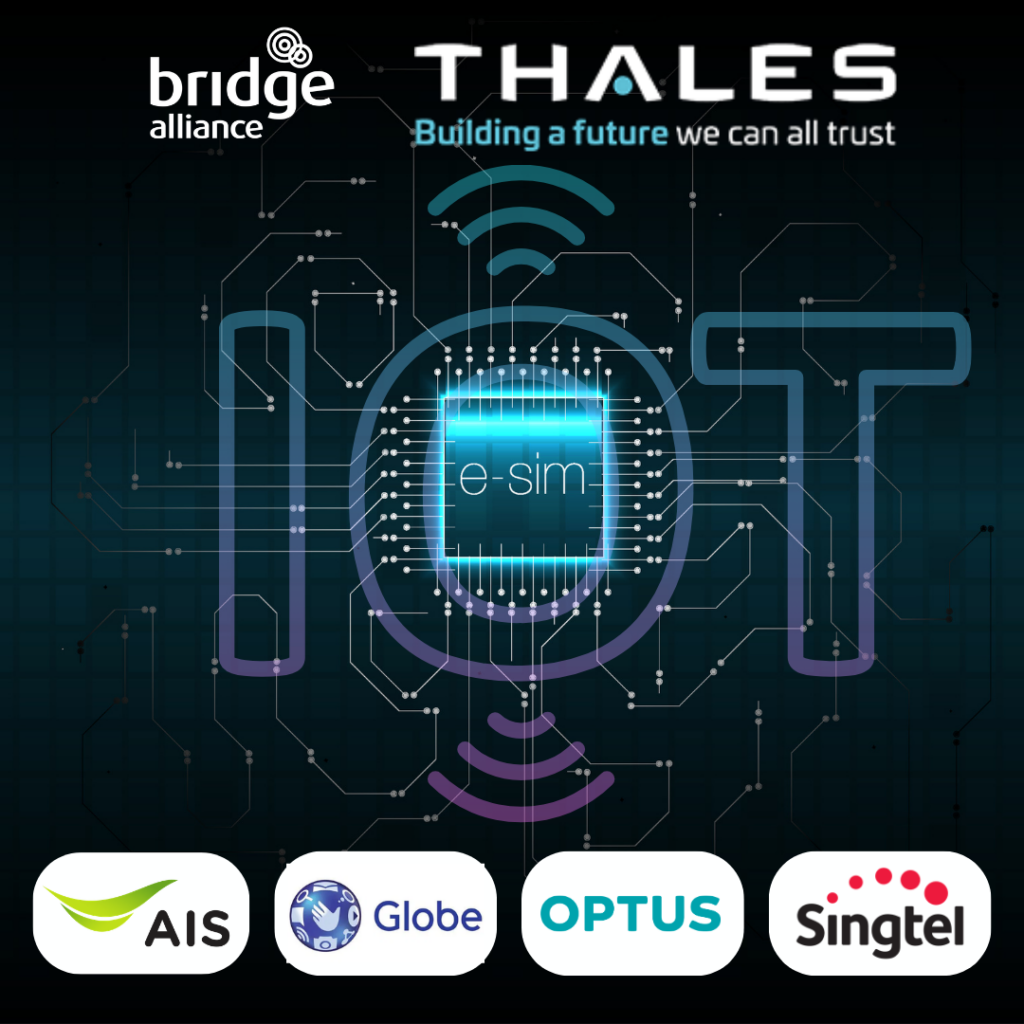
Bridge Alliance member operators and Thales, a global leader in secure connectivity and eSIM technologies have successfully deployed the world’s first multi-operator enterprise eSIM connectivity network for IoT. This breakthrough, achieved by AIS (Thailand), Globe Telecom (Philippines), Optus (Australia) and Singtel (Singapore) enables enterprises to remotely manage connected devices across multiple countries and networks through a single, centralised solution, simplifying the deployment and lifecycle management of connected devices across Asia Pacific.
Businesses increasingly rely on connected devices. GlobalData forecasts the region’s cellular IoT and M2M connections will grow to 1.3 billion by 2030, underscoring a need for scalable connectivity solutions that can support a widening range of IoT applications across industries – from smart vehicles and payment terminals to utility meters and industrial equipment.
Currently, enterprises deploying connected solutions across markets face complex logistical challenges including fragmented management systems and operator-specific provisioning. Costly manual interventions are also required to resolve connectivity-related issues.
The new centralised platform, developed via a collaboration between Thales and Bridge Alliance member operators AIS, Globe Telecom, Optus, Singtel, and built on Thales’ end-to-end IoT eSIM solution, enables enterprises to deploy connected products without being tied to a single operator. The platform is powered by the latest GSMA SGP.32 specification, widely regarded as the next evolution of IoT eSIM technology, and an advanced orchestration capability developed by Thales. Successful testing was completed using devices leveraging the new SGP.32 standard, utilising both the IoT Profile Assistant Embedded (IPAe) and the IoT Profile Assistant on Device (IPAd). The impact to enterprises is they can now automatically manage connectivity for entire fleets of devices throughout their lifecycle and across borders, significantly reducing operational complexity while improving service continuity.
“The expansion of the SGP.32 standard across multiple Asia-Pacific markets represents a major milestone in realising Bridge Alliance’s vision to enable truly regional enterprise IoT connectivity. Building on the success of the proof-of-concept, we are proud to help accelerate the adoption of a common eSIM framework with Thales and our member operators and simplify IoT deployment across multiple markets,” said Loo Boon Chee, CEO of Bridge Alliance. “This initiative demonstrates the power of our ecosystem collaboration in unlocking more IoT business opportunities and revenue for not only our member operators but also Bridge Alliance technology partners like Thales, which gain quick and valuable access to our regional footprint.
“At AIS Business, we are committed to empowering enterprises with trusted digital connectivity that enables sustainable business growth and digital transformation. As Thailand’s leading digital service provider, we are proud to collaborate with Bridge Alliance and Thales in delivering the world’s first multi operator enterprise eSIM connectivity network for IoT. This achievement reflects our commitment to developing innovative digital infrastructure that helps businesses simplify connectivity management across multiple markets. By enabling enterprises to deploy, manage and scale connected devices through a single platform, the solution reduces operational complexity while enhancing service continuity, security and flexibility. We believe this innovation will accelerate IoT adoption across Thailand’s key industries, including manufacturing, logistics, automotive, utilities, retail and smart infrastructure, while strengthening the country’s digital competitiveness across the region,” said Phupa Akavipat, Chief Enterprise Business Officer, AIS.
“The Philippines has an opportunity to play a bigger role in the region’s digital economy, and that starts with giving businesses the right digital foundations to grow beyond our borders,” said Carl Cruz, President and CEO of Globe Telecom. “Globe is proud to have provided the platform that helped bring this collaboration to life alongside Bridge Alliance, Thales, and our fellow member operators. This milestone gives enterprises the confidence to scale faster across Asia Pacific while unlocking new opportunities for innovation and growth.”
“As enterprises scale connected services across markets, they need seamless, easy-to-manage connectivity. Our collaboration with Thales combines the latest eSIM standards with intelligent automation enabling businesses real time visibility and control of their IoT devices across multiple geographies through a single eSIM orchestration platform. The innovative solution simplifies large-scale IoT deployments across the region, helping enterprises achieve greater operational efficiency and economies of scale while maintaining secure, reliable connections wherever they operate,” said Jorge Fernandes, Group Chief Technology Officer at Singtel. “The successful completion of testing with Singtel, Optus, AIS and Globe Telecom marks an important step towards enabling the next generation of IoT innovation across Asia Pacific.”
Through the platform, enterprises can localise connectivity as devices enter new markets. Devices automatically connect to the optimal local network, switch between participating operators and maintain uninterrupted service without manual intervention or a physical SIM replacement. This reduces operational costs and improves resilience through automatic network fallback and recovery mechanisms.
“This milestone demonstrates how the industry can work together to simplify connectivity for enterprises operating across borders,” said Nicolas Bouverot, VP Mobile Connectivity Solutions at Thales. “By bringing multiple operators together on a single orchestration platform, we are helping businesses deploy and manage connected devices more efficiently while ensuring the flexibility and resilience required for large-scale IoT deployments.
The solution is particularly relevant for industries that depend on reliable, long-term connectivity:
- Connected vehicles can maintain seamless connectivity across borders, supporting navigation, safety services and over-the-air software updates.
- Utilities and smart metering providers can remotely manage millions of devices over many years without costly on-site interventions.
- Retailers and payment providers can ensure payment terminals remain connected, reducing the risk of lost transactions.
- Infrastructure operators can centrally manage connectivity across routers, gateways and fixed wireless access equipment deployed in multiple locations.
Following the successful deployment and testing with four regional operators, the partners plan to expand the solution to additional Bridge Alliance member operators. Supported by the Bridge Alliance Technology Partner Programme, this collaboration with Thales underscores a shared commitment to extending seamless enterprise IoT connectivity across the region.