

Quarterly Insights on Bridge Member Operators: 2Q2026
Hi all!
Here’s our edition of 2Q2026 news for the Bridge Alliance community. Across this quarter’s announcements, the industry appears to be moving from technology positioning to operational and commercial execution. Telcos are trying to evolve from connectivity providers into autonomous, secure and sovereign digital-infrastructure operators—but they are under growing pressure to prove revenue, cost savings and customer outcomes.
- AI is beginning to show measurable economics—not just strategic ambition. 2Q contains some of the first stronger evidence that telco AI is contributing to financial performance. The AI opportunity is developing along three commercial paths:
- reducing operating and service costs;
- improving customer retention and ARPU;
- selling AI infrastructure, tokens and managed AI services.
- The autonomous telco is emerging as the target operating model. AI is moving beyond individual copilots and automation tools toward a broader autonomous operating model.
- Sovereignty is becoming a full-stack product category; 2Q shows sovereignty becoming more operational and commercially packaged. Sovereignty now means more than storing data locally. A credible proposition must address: where data is stored and processed; who operates the platform; who controls encryption keys; which models and chips are used; whether workloads can be audited; whether the customer can switch providers; and how services comply with local law.
- Satellite–terrestrial convergence is turning resilience into a product. Satellite is no longer being positioned solely as a remote-connectivity niche. It is becoming part of the operator’s broader architecture for: coverage extension; disaster response; enterprise backup; remote IoT; maritime and aviation; government and defence; and mission-critical communications.
- Enterprise growth is moving toward vertical, managed outcomes. Across AI, IoT, cloud, enterprise and customer engagement, operators are packaging technologies around concrete industry problems.
- Data, context and APIs are becoming the execution layer. 2Q’s UC/CPaaS releases emphasized persistent context, conversation memory and front-to-back-office workflow execution. Customer-engagement platforms are attempting to preserve customer history across channels, route work across humans and AI agents, and connect conversations directly to CRM, ERP, service-management and fulfilment systems.
If you were at MWC Shanghai in June, you might have caught the Bridge Team there. Our CEO Boon Chee spoke about what we’re doing on telco APIs at the Future Networks Summit (watch on demand if you missed it!). On this API note, we’re jointly organising the Global API Forum in Singapore on 3 November, with Aduna Global – it’s already open for registration!
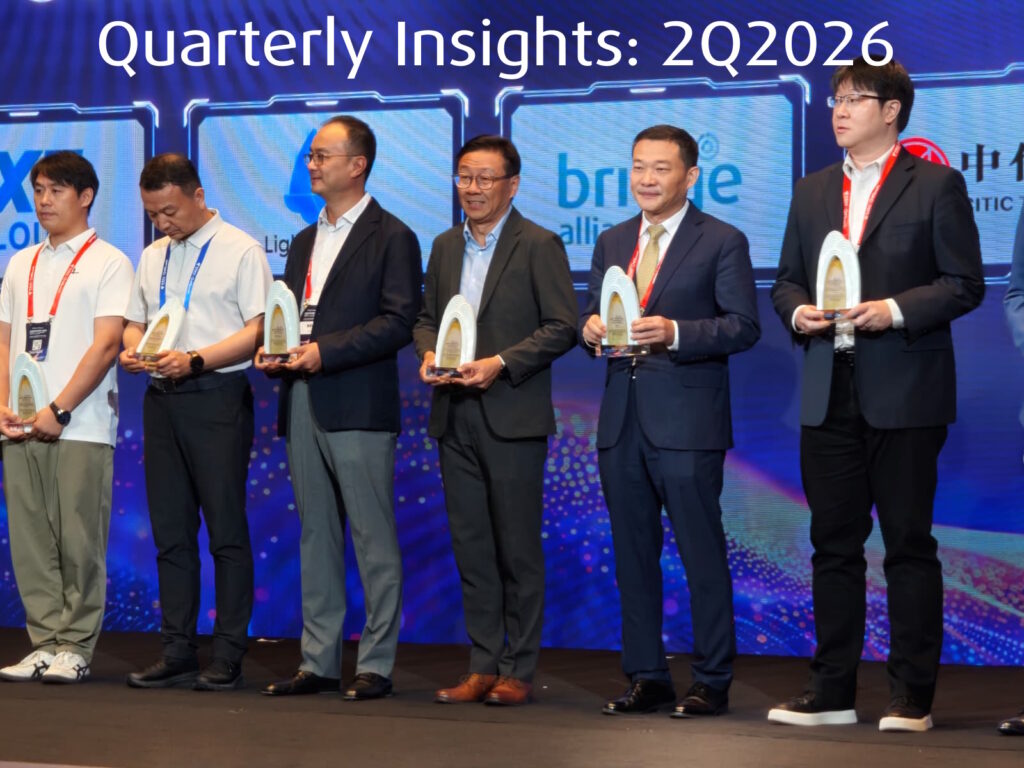
On behalf of Bridge, Boon Chee also attended China Telecom Global’s OneGrowth 2026 Partner Conference, where we were deeply honoured to receive the “Best Product Innovative Partner” award and where fellow Bridge Member Operators (BMOs) AIS, HKT, Singtel, and SK Telecom were recognized as “OneGrowth Best Innovative Carrier Partner”. Another event that Boon Chee attended in June was this year’s FreeMove Summit in The Hague, hosted by Dutch operator Odido. These were great opportunities to renew our connections with both Asian and European counterparts.
Read on for more news about Bridge Alliance and our BMOs in the last quarter!
Cheers
Bridge Alliance Research & Analysis Team
5G & Innovation
Satellite connectivity is one of the quarter’s strongest themes. Satellite is becoming an integrated extension of the mobile network. Globe launched Starlink satellite-to-mobile service in the Philippines, initially supporting essential messaging and light data where terrestrial networks are unavailable. Deutsche Telekom launched a fully managed Starlink service for German enterprises and public-sector customers.
Network resilience is becoming a first-class product attribute; a significant proportion of the quarter’s innovation activity concerns continuity during disasters, infrastructure failures or hostile conditions. Globe positions satellite-to-mobile as a safety net during calamities and power outages, while Deutsche Telekom is selling satellite broadband as enterprise backup and redundancy.
Besides satellites, another hot move onto operator roadmaps is quantum-safe networking. SK Telecom joined a European research initiative focused on quantum key distribution using photonic integrated circuits and AI.
5G-Advanced and Standalone are shifting the conversation toward network capability. AIS launched 5G-Advanced, using three-component-carrier downlink and two-component-carrier uplink aggregation. Meanwhile, Optus and Ericsson achieved a world’s first when they demonstrated 180 MHz aggregation across 2.3 GHz and 3.5 GHz spectrum on a live 5G Standalone network.
Future-network research is becoming AI-native, semantic and sovereignty-driven, while innovation is increasingly ecosystem-led and focused on industrialization. HKT and Hong Kong Applied Science and Technology Research Institute (ASTRI) signed a MoU to establish a Joint Research and Development Laboratory (the HKT-ASTRI Joint R&D Lab) at the Hong Kong-Shenzhen Innovation and Technology Park (HSITP). The initiative aims to advance digital transformation across enterprises.
More 5G and innovation news:
- Metfone officially launched consumer 5G plans in Cambodia on 1 April after three months of technical trials
- Deutsche Telekom and German arms manufacturer Rheinmetall plan to develop a drone defense shield
- In Malaysia, Maxis together with CelcomDigi and YTL inject additional RM202 mil each into DNB for spectrum acquisition
Private networks
- Private 5G is being framed less as a standalone network and more as a managed enterprise solution; the strongest common thread is that private 5G is increasingly being sold as a managed service with repeatable delivery, rather than a bespoke connectivity project.
- AI and edge intelligence are starting to be bundled into the private 5G story; private 5G is no longer just about connectivity. It is being linked more directly to edge AI and physical AI outcomes.
- Scale and repeatability are becoming more important than one-off pilots; the market is moving beyond isolated flagship pilots toward multi-site and scalable deployment models.
AI
The 2Q announcements show telco AI moving from experimentation toward industrial deployment and commercialization. Operators are investing simultaneously in AI infrastructure, autonomous operations, sovereign platforms, sector-specific solutions and AI-enabled security.
Telcos are building full-stack AI infrastructure businesses; the largest strategic theme is the expansion of operators into AI data centres, GPU clouds, AI factories and sovereign compute platforms. Here are the many strides taken by BMOs in AI infra:
- SK Telecom and NVIDIA are planning gigawatt-scale AI factories The two companies have agreed to pursue collaboration on a ‘Full Stack AI Cloud’ encompassing everything from chips to data center operations, based on the NVIDIA DSX platform
- SoftBank launching an AI Data Center GPU Cloud with inference-as-a-service and Kubernetes capabilities.
- Singtel RE:AI expanding sovereign GPU-as-a-Service and high-performance AI data infrastructure across ASEAN, in partnership with WEKA
- Deutsche Telekom building a sovereign AI platform for the German government.
- Alibaba and China Telecom deploying a data centre based on domestically developed AI chips.
- China is turning to telcos, namely China Telecom and also China Mobile with networking vendor Huawei to see through its 2tn yuan ($295 billion) initiative to build AI datacentres across the country during the next five years.
Agentic AI is moving from demonstration into operations; agentic AI appears in 2Q in network management, IT operations and enterprise workflow automation. Deutsche Telecom’s IT arm T-Systems is embedding AI observability and automation into managed services, moving toward proactive and self-healing IT operations. Deutsche Telekom and n8n, a fast-growing European AI and agent orchestration company to help SMEs implement auditable AI-agent workflows. Meanwhile, Taiwan Mobile is partnering Visa to Build Taiwan’s First AI Agent Commerce Consumer Use Case
Enterprise AI is becoming vertical, operational and outcome-led; Operators are moving away from generic “access to AI” propositions and building solutions around specific industries and workflows. Among BMOs, SK Telecom is developing proprietary manufacturing agents for steel and automotive-parts factories, SKT’s NVIDIA Omniverse digital twin targets semiconductor-factory automation. du is deploying industrial computer vision for quality inspection, traceability and factory optimization in partnership with a pipe company, while Globe and Netopia AI are testing predictive marketing before media expenditure is committed.
Sovereignty and localization are becoming central product features. Besides Deutsche Telekom is building the AI platform supporting Germany’s public-administration stack, while T-Systems and SupplyOn are bringing AI to Europe’s supply chains while ensuring the customers retain full control over their data.
du announced the launch of its secure next-generation industrial AI platform under du Tech’s portfolio, specifically designed to serve the industrial sector in the UAE.
Singtel and Mistral are targeting sovereign AI solutions for finance, defence, government and healthcare. SoftBank’s Sarashina combines a Japanese language model with locally controlled Oracle-based cloud infrastructure.
Cybersecurity is emerging as one of the strongest AI monetization opportunities: SoftBank’s Patching as a Service uses AI to identify vulnerabilities and assist remediation planning, while stc Bahrain launched an AI-enabled autonomous cyber-defence centre capable of detection, investigation and automated response.
No one is to be left behind and partnerships are in order to grow AI across sectors so that everyone benefits, with TelecomTV’s founding of the AI-Native Telco Accelerator (ANTA) community, an industry-backed initiative designed to help CSPs ) move from AI experimentation to deployment – Deutsche Telekom is one of five founding members.
AIS Business and Microsoft launch “AI Ready for SMEs”, accelerating secure AI adoption for Thai SMEs. Taiwan Mobile is too, expanding its AI suite to SMEs and addressing common barriers to adoption. The Singtel Group announced a strategic partnership with Digital Industry Singapore (DISG) to accelerate a multi-year AI transformation programme across its businesses and strengthen its capabilities in AI-enabled operations, digital infrastructure, customer platforms and workforce development. This was in addition to Singtel Singapore’s launch of AI.dea — an AI business transformation programme, developed in partnership with SIM Academy that specifically helps SMEs accelerate AI adoption.
Globe Business has formalized a two-year strategic partnership with the Analytics and Artificial Intelligence Association of the Philippines (AAP) to help organizations move beyond AI experimentation to everyday use.
Meanwhile, AI Tokenisation is a topic we’re starting to watch closely, which dominated the conversation at the recent MWC Shanghai in end June. China has gotten a headstart, with the likes of China Telecom launching a trial of commercial AI token subscription plans that allow users to leverage its AI compute power.
More BMO AI news:
- Globe Telecom said it is allocating PHP56 billion this year for network upgrades, infrastructure expansion, and data center investments as it expands AI capabilities
- Globe Business empowers Philippine enterprises with context-rich, real-time AI through new managed data streaming platform
- Maxis partners LG Uplus to launch ixi-O AI calling in Malaysia
- Singtel Digital InfraCo’s RE:AI powers faster, scalable research at NTU Singapore
- SKT Joins Hands with Japan’s NTT and Taiwan’s Chungwa to Expand Cross-Border AI Ecosystem
- T-Systems and Scheer Group form partnership in process automation
IoT/M2M/mobility
There is a clear continuation of themes from the previous quarter in terms of the integration of cellular and satellite connectivity into a common IoT proposition. The target use cases remain highly practical: agriculture, maritime, logistics, utilities, environmental monitoring, and other remote operations. Telenor IoT and Sateliot are working to let standard NB-IoT devices move between terrestrial networks and LEO satellites without proprietary hardware.
SGP.32 is moving from roadmap to commercial deployment. 2Q provides stronger evidence that the new GSMA IoT eSIM standard is becoming operational. Axentia became the first named customer to commercially deploy Telenor IoT’s standardized SGP.32 solution.
IoT security is becoming network-native and agentless. Security is moving deeper into the connectivity layer rather than being installed separately on every device. On this note, to help businesses navigate this complexity, we’ve teamed up with our IoT platform partner Aeris and leading IoT news portal IoT Now to launch the new 𝗕𝗿𝗶𝗱𝗴𝗲 𝗔𝗹𝗹𝗶𝗮𝗻𝗰𝗲-𝗔𝗲𝗿𝗶𝘀 𝗜𝗼𝗧 𝗛𝘂𝗯 that tells you more about Aeris’ IoT Watchtower. This dedicated intelligence hub brings together the use cases, videos, and strategic frameworks you need to seamlessly deploy and protect global IoT networks.
Automotive and fleet connectivity remain major growth anchors. Connected vehicles and fleet management remain among the most commercially mature IoT categories. Globe joined hands with our IoT platform partner Aeris to bring the latter’s IoT Acclerator platform to the Philippines, aimed partly at connected vehicles and software-defined automotive ecosystems. stc Bahrain and the Arab Shipbuilding and Yard Repair Company (ASRY) show the same trend in industrial fleet management.
Global IoT platforms are consolidating and attracting dedicated investment. Aeris and KDDI renewed a major connectivity-management relationship around the management of more than 100 million devices. Soracom expanded professional services into North America to help customers move from pilot projects to large-scale production.
More mobility news:
- AIS Presents Intelligent Digital Technologies at the Global Telecom AIoT Summit 2026 Emphasizing IoT Solutions
- Metfone Express Debuts As Competition Intensifies In Cambodia’s Growing Logistics Industry
- Transerco and MobiFone Hanoi cooperate to promote digital transformation of public transport
Edge/MEC/Cloud
On the cloud and edge front 2Q2026 announcements also point to propositions converging around sovereign, AI-ready, network-integrated infrastructure. The quarter places much greater emphasis on practical routes to market: government procurement frameworks, regulated-industry solutions, migration services, secure cross-border access and verticalized cloud platforms.
Sovereign cloud is moving from strategic positioning to commercial delivery; Sovereignty is the dominant theme across the announcements, but the important development is that it is becoming an operational product rather than simply a marketing claim.
Among BMOs Deutsche Telekom’s T Cloud Public has been added to a German government framework that allows public institutions to procure cloud and AI resources more easily. In the Middle East, du is offering a UAE sovereign cloud specifically for Chinese companies entering the region.
AI and industrial workloads are becoming the main demand drivers; the recent cloud and edge announcements are increasingly tied to AI workloads rather than traditional enterprise hosting. The EDAG Group, a global independent engineering services provider will run its industrial metaverse platform metys on Telekom/T-Systems’ T Cloud Public.
Partnerships and acquisitions remain the main route to capability; every significant announcement depends on an ecosystem: Deutsche Telekom supplies infrastructure while EDAG supplies the industrial applications and expertise. Our technology partner Oracle and IBM are extending their partnership around agentic AI, automation, enterprise applications and hybrid cloud.
Enterprise
The 2Q enterprise announcements show telcos concentrating on these areas: global scale, managed cybersecurity, resilient mission-critical communications, public-sector and industrial transformation, and expansion into data-led digital platforms. The overall direction is clear: enterprise telecom is moving away from standalone connectivity contracts toward integrated, regulated and outcome-based services.
Global enterprise connectivity is consolidating around fewer, larger platforms, with the most strategically significant announcement is the planned BT–Verizon international enterprise joint venture. The quarter also showed substantial ownership consolidation.
Cybersecurity is becoming the centre of the enterprise telco proposition: Deutsche Telekom and Palo Alto Networks launched a sovereign managed cyber-defense service for regulated European customers; while Airtel Business launched a fully managed zero-trust platform for hybrid workforces.
Resilient and mission-critical communications are becoming a differentiated enterprise category, while government and industrial transformation are becoming anchor enterprise verticals. A number of announcements involve telcos acting as long-term digital-transformation partners to governments, cities and industrial ecosystems.
- In Vietnam, MobiFone and Dong Nai City signed a digital transformation cooperation agreement and will cooperate on digital government, infrastructure, the digital economy and AI-enabled sector applications.
- du and the Abu Dhabi Investment Office signed a strategic partnership to support the UAE
- Globe and the wider Ayala group are exploring smart cities, digital finance and data-driven platforms in the Philippines, with the collaboration of Japanese partners like KDDI, Mitsubishi and MUFG
Telcos are expanding enterprise growth through data, platforms and adjacent ecosystems. SKT established Public-Private Data Alliance for Small Business Owners integrating public and private data like pedestrian traffic, sales, and financials for data exchange and joint research.
Customer wins
Here are a few major customer wins from our BMOs this past quarter:
- AIS Business is providing advanced digital solutions and 5G and fibre infrastructure for the Eastern Gateway (ARAYA), a massive smart industrial estate project in Samut Prakan, Thailand
- Deutsche Telekom’s IT service provider T-Systems is setting up Volkswagen’s new private cloud
- T-Systems is offering its TI-Connect software to DENS, a Berlin-based dental software manufacturer
- In Malaysia, Maxis has secured an award from Telekom Malaysia Bhd subsidiary TM Technology Services to continue providing 2G and 4G domestic roaming services and 4G multi-operator core network services.
Telco APIs
In the domain of telco APIs, even though 2Q was relatively quiet, the market direction remains consistent. Telco APIs are moving into commercial deployment, but monetization remains heavily concentrated around fraud prevention, authentication and digital identity.
The quarter also shows that operators are increasingly relying on aggregators, CPaaS providers and developer platforms to distribute their APIs. The main challenge is therefore shifting from technical standardization to commercial reach, developer adoption and repeatable revenue.
- Fraud prevention remains the dominant commercial use case; every operator-led commercial launch in the file is centred on security and identity.
- Multi-operator aggregation is becoming the default route to market; the announcements repeatedly rely on common platforms rather than direct, individual operator integrations.
- Network APIs are progressing from trials to national commercial coverage; the quarter includes tangible commercial launches rather than only proofs of concept.
- Developer access is moving into AI-native development environments: Vonage’s integration with AWS Kiro is one of the quarter’s most forward-looking announcements.
- Standardization has advanced faster than monetization breadth.
We are joining Aduna to organize the first ever Global API Forum, taking place on 3 November 2026 in Singapore! Save your seat for this full-day event held in Singapore. It will bring together leaders from across the telecom and technology ecosystem to explore the challenges, opportunities, and real-world applications of APIs.
Unified Communications/CPaaS
Unified communications, CPaaS and customer engagement are moving beyond conventional communications software toward AI-native service and workflow platforms.
The defining change is not simply that vendors are adding more AI features. Vendors are building platforms where autonomous agents, human employees, communication channels and enterprise workflows operate through one coordinated system. At the same time, governance, sovereignty and industry-specific deployment are becoming essential for enterprise adoption.
Some trends:
- Agentic AI is moving from chatbot assistance to autonomous resolution; The strongest trend is the transition from rule-based bots and agent copilots to AI agents that can complete multi-step customer journeys.
- Human and AI agents are becoming one managed workforce; this theme is around the emergence of a combined operating model for human employees and AI agents.
- UC, CCaaS and CPaaS are converging into enterprise orchestration platforms; the lines between communications, customer service and business workflow platforms continue to blur.
- Persistent context and conversational data are becoming the key intelligence layer; many Q2 announcements focus on maintaining context across channels, systems and interactions.
- Governance, sovereignty and specialization are becoming prerequisites for scale; As AI agents become more autonomous, enterprises require greater control over where data is processed, which models are used and what actions agents can take.
. . . . .



