



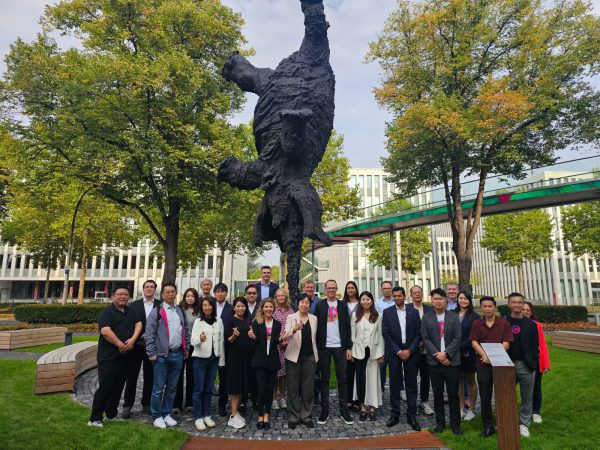
The Bridge Alliance team on a working visit to Deutsche Telekom headquarters in Bonn, Germany in September 2025.
Hello everyone!
We’re into the last quarter of this year – which means our annual CXO Forum is coming up and we’re hands full with preparations! While the CXO Forum is closed door as usual, our first-ever Telco API Forum on 18 November is open to everyone – register now to attend, if you’ve not done so and are based right here in Singapore!
In the midst of the frenzy, here’s the news on Bridge Alliance and our member operators’ (‘BMOs’) activities in the past quarter.
Telecom operators worldwide have been accelerating their evolution from infrastructure providers to platform-driven enablers of digital transformation. Across Asia, Europe, and emerging markets, telcos expanded their capabilities through APIs, AI, 5G-A, cloud-native networks, and vertical-specific solutions. The key shift this past quarter was the commercial maturity of programmable telco infrastructure—monetised through network APIs, edge intelligence, and federated models.
With regards to IoT, we see space & terrestrial convergence: Operators like Deutsche Telekom, PCCW Global, and Chinese vendors are deploying NB-IoT over LEO satellites to offer truly global coverage. IoT is going deeper into automotive, utilities, public safety, and manufacturing, with satellite backhaul and AI at the edge becoming standard components.
In terms of enterprise transformation, telcos are becoming strategic digital partners to governments and vertical sectors, offering regulated cloud, cybersecurity, AI, and financial fraud solutions. Telco APIs are no longer experimental—identity, KYC, and anti-fraud APIs are monetising now via global aggregators, CPaaS, and cloud marketplaces.
In terms of 5G Innovation, 5G-Advanced is here—with slicing, AI, positioning, and cloud-native orchestration. Use cases are real, spanning events, transport, and industry.
Unified communications & CPaaS: Agentic AI and omnichannel are everywhere; The future of communications is API-first, AI-powered, and omnichannel-native—with messaging, voice, video, and automation unified into one layer.
GenAI is not yet a revenue engine for telcos—it’s mostly cost-focused; Most telco GenAI initiatives (e.g. AI chatbots, call summaries, agentic assistants) are cost-saving measures, not new revenue drivers.
Telcos are now AI infrastructure providers, powering sovereign AI models, LLM deployment, GPUaaS offerings, and trusted digital ecosystems. However, at this stage, telcos are building AI infra for others—but not monetising it for themselves yet.
Read on for more!
Regards
Bridge Alliance Research & Analysis Team
AI
AI agents have emerged as the centerpiece of many telco AI strategies—serving both customers and internal operations. These agents will increasingly orchestrate everything from plan changes to smart home commands. AI is also now embedded in network insight, planning, and optimisation tools; AI agents are managing real-time traffic, predicting outages, optimising energy, and reconfiguring the network for service intent.
Telcos are exporting AI as a solution layer for enterprise transformation; they are now offering AI-powered business platforms, often bundling analytics, automation, and infrastructure as integrated solutions, and driven by data privacy, regulatory needs, and cultural relevance, telcos are investing in in-house or regional LLMs.
SK Telecom was again very active on the AI front. In August, SKT launched its new sovereign AI Infrastructure, providing GPU-as-a-Service (GPUaaS) based on the latest NVIDIA Blackwell GPUs. SKT will work with VAST Data on this infrastructure, named the ‘Haein’ cluster, to virtualise graphics processing unit (GPU) resources, streamline AI data pipelines, and support national-scale AI model training and inference. It is expected to play a central role in developing national AI foundation models in South Korea.
Meanwhile, the SK AI Data Center Ulsan, currently under construction as the largest AI-dedicated data center in Korea, will be equipped by Schneider Electric, the world’s leading MEP (mechanical, electrical, and piping) equipment company. This contract also includes Schneider’s ETAPSKT’s integrated AI DCIM (Data Center Infrastructure Management) solution. The plan also includes integrating the system with digital twins to optimise operations.
SKT announced the release of its new proprietary standard large language model (LLM), ‘A.X 3.1’. It is enhancing its LLM capabilities through a dual-track strategy. The A.X 3 series represents a sovereign AI model, fully developed in-house, emphasising self-sufficiency, while the A.X 4 series focuses on LLMs optimised for the Korean business environment. This was followed days later by another visual language model based on its LLM, AX (Adot X), and a general-purpose document interpretation technology for LLM learning. SKT is also collaborating with Krafton, a game publisher, on open-source LLMs to expand game-focused AI technology.
SKT’s AI service ‘A.’ (A dot) was upgraded and deployed across mobility (T Map), customer service, search, spam prevention and document understanding with advanced Korean LLMs. SKT has also inked a strategic partnership and investment agreement with TimeTree, a global schedule-sharing platform company, on September 5 to jointly develop AI agent services and apply A.’s and agentic workflow to Timetree to suggest optimised activities tailored to users’ schedules and preferences.
In Australia, Optus has launched an agentic AI solution in the form of Optus Expert AI to empower and assist existing frontline staff with real-time intelligence, helping them to deliver a faster, better and more streamlined customer experience with the help of advanced GenAI capabilities and natural language understanding with real-time orchestration.
AIS in Thailand and ZTE Corporation have successfully validated the Network Insight Agent. The live-network demonstration marks a major step forward in AIS’s autonomous network evolution, powered by AI models, and establishes a solid foundation to boost network optimisation across coverage, capacity, and infrastructure. Stc Group is also delivering AI-powered self-optimising network (SON) capabilities to enhance voice call quality and data speeds in central Saudi Arabia; with Huawei’s help.
In Japan, SoftBank and SB Intuitions, its subsidiary dedicated to developing homegrown LLMs specialised in the Japanese language, are partnering Dentsu Inc. and Dentsu Digital Inc. to jointly conduct research on the development of a genAI specialised in Japanese copywriting, starting in September 2025 to enable richer creative output in advertising. Softbank is also collaborating with financial giant Mizuho to introduce cutting-edge AI to streamline operations and improve customer service, in the form of “Cristal intelligence,” which is being developed jointly by SoftBank and OpenAI.t
To support its AI efforts, SoftBank in July deployed a DGX SuperPOD with DGX B200 systems exceeding 4,000 NVIDIA Blackwell GPUs. This makes SoftBank’s AI computing platform currently the world’s largest NVIDIA DGX SuperPOD with DGX B200 systems*1. It will initially be utilised by SB Intuitions Corp..
Over in Europe, Deutsche Telekom is partnering n8n, a German unicorn which is a specialist in the digitisation of repetitive workflows to develop AI agents for medium-sized enterprises. DT has also launched ‘Voice AI Notes’ for SMEs to summarise business calls. The service is operated on Mistral AI’s Mistral Small 3.
In Indonesia, Telkomsel and Mobileum are collaborating to deliver high-impact, AI data-driven solutions that help Indonesian enterprises unlock growth, drive innovation, and improve operational efficiency with the help of Mobileum’s Deep Network Analytics (DNA) platform.
Operators continue to offer AI to their subscribers, the latest being Airtel’s bundling of a 12-month Perplexity Pro subscription free of cost to all its 360 milliion customers.
The expansion of AI also means that operators are taking action to ensure manpower must meet the needs for AI expertise. In Singapore, Singtel made a strategic push to equip all employees with knowledge and capabilities in AI and will accelerate employee upskilling to build AI, emerging tech, sustainability and power skills. Taiwan Mobile also announced a “Superman Project” aimed at equipping employees with the know-how to implement AI tools across all of the company’s business segments.
IoT/Mobility/NTN
In IoT news, satellite IoT is moving from concept to deployment. The implication is that the convergence of space and terrestrial networks is unlocking ultra-wide IoT reach—especially for mobility, logistics, agriculture, and remote assets—positioning satellites as a key layer in the 5G-era IoT.
There were some interesting IoT-related announcements made by our BMOs:
Deutsche Telekom & Iridium announced integration of NB-IoT direct-to-device connectivity via LEO satellites for seamless global IoT coverage while PCCW Global & Beijing Guodian High-Tech Technology Co., Ltd launched satellite NB-IoT services across Hong Kong, Macau and Belt & Road regions using the TianQi IoT Satellite Constellation to deliver low-cost, low-power, long-range data transmission for IoT devices. PCCW Global also signed a strategic collaboration framework agreement with the Lower Air Space Economy Research Institute of the International Digital Economy Academy (IDEA-LASER) to jointly develop Smart Integrated Lower Airspace System (OpenSILAS), the city-level low-altitude airspace intelligent management system, and its related technologies for global markets.
Over in Australia, an Optus-led consortium announced it would commence the build-launch and operation of a sovereign LEO Satellite, targeting a launch date of early 2028. It will be built by Inovor Technologies at Lot14, in Adelaide, South Australia and Optus intends to operate the spacecraft from its Belrose Space Operations Centre in Sydney.
Airtel Business has entered into a strategic partnership with precise-positioning-technology leader, Swift Navigation, to launch India’s first AI/ML-powered, cloud-based location service, Airtel-Skylark Precise Positioning Service. This service will improve accuracy by up to 100x when compared to standard Global Navigation Satellite System (GNSS) to deliver a reliable and easily accessible centimetre-level-accurate positioning service for mission-critical, location-based applications for large-scale deployment. Taiwan Mobile has similarly partnered Swift Navigation to bring Skylark to the Taiwanese market.
This September, the Chinese government granted China Unicom a license to operate satellite mobile communication services, enabling the carrier to deliver direct-to-cell satellite coverage for emergencies, maritime traffic and remote regions. It joins China Telecom, which previously acquired the license in 2023.
In July, China Unicom Smart Connection Technology, a subsidiary of China Unicom, announced the China Unicom intelligence global Internet of Vehicles (IoV) platform and an automated vehicle transport system for automotive factories. It enables cross-border interconnection and local service with single-point access for Chinese automakers going global and currently serves 22 automotive brands across 68 countries.
Taiwan Mobile announced that its MyCharge charging network will be further expanded to all counties and cities in Taiwan, covering more than 100 locations and 550 charging piles by the end of 2025.
Security concerns are triggering proactive solutions, as in the case of Bridge Alliance and our IoT platform partner Aeris launching IoT Watchtower, a “zero-touch” threat detection and enforcement layer for enterprise IoT devices for participating BMOs. Operators and vendors are embedding compliance, threat detection, and resilience into IoT offerings from the start.
5G and Innovation
On the 5G front, operators continue to migrate to 5G-Advanced, focusing on intelligent network features, industrial-grade performance, and AI integration. They are investing in sector-specific platforms and labs to co-create with industries and are embedding 5G into vertical strategies—creating dedicated testbeds and slicing-enabled offerings for real-world industries.
As 5G unlocks low latency and always-on coverage, precision location becomes a strategic layer—enabling new categories like autonomous delivery, smart construction, and AI-driven transport planning.
Globe conducted the Philippines’ first 5G-Advanced Successful Live Pilot trial, recording an impressive peak download throughput of ~2.5 Gbps in a real-world environment, while China Unicom powered the world’s first humanoid robot games, providing full 5G-A network coverage outside and inside the venue in Beijing.
In Vietnam, the Department of Telecommunications has committed to expediting cooperative agreements and declared that VNPT and Viettel must share infrastructure with MobiFone, while Malaysia’s unique special purpose 5G vehicle DNB received a capital injection from local carriers.
Private Networks
Private 5G networks are proving their worth in event tech, sports, and media—where latency, reliability, and localised coverage are non-negotiable. These deployments double as public showcases of 5G’s enterprise-grade performance. Government spectrum policies are accelerating enterprise 5G, with regulators playing a proactive role in fostering non-public networks by setting aside dedicated spectrum, which lowers the barrier for enterprises to build and experiment with 5G-powered automation without needing MNO intermediation.
Looking at the announcement by Softbank and Sumitomo, there is a clear push toward intelligent edge terminals that can process data on-device for low latency, reducing dependency on centralised infrastructure and cloud round trips. This enables AI-at-the-edge in industrial settings; SoftBank and Sumitomo Electric showcased industrial-grade AI-capable 5G terminals, including waterproof, dustproof millimeter wave devices and edge-enabled processing via Docker containers.
Edge/MEC/Cloud
Cloud sovereignty is now a basic requirement for telcos that want to serve the public sector, regulated industries, or support national digital transformation. In the last quarter, several operators moved beyond simply using third-party clouds and began acting as cloud providers themselves—building national cloud platforms tailored for data residency, AI workloads, and industries with strict security or compliance needs.
Cloud-Edge convergence is real. Platforms like Deutsche Telekom’s T Cloud AI and stc’s ICC illustrate how telcos are embedding AI, graphics processing, and low-latency services into edge clouds, particularly for industrial, media, and gaming use cases. Revenue will shift toward edge-enabled digital experiences, not just connectivity;
There were a handful of BMO announcements in this space–stc group rebranded its cloud subsidiary as Saudi Cloud Computing Company as ‘sccc by stc’, reinforcing its role in delivering 100% local, regulation-compliant hyperscale cloud services for public sector and key industries in Saudi Arabia. Separately, stc also entered into a strategic collaboration with CloudSky that will see the latter’s Immersive Cloud Computing (ICC) help the telco unlock new revenue streams by enabling more high-value digital application scenarios on its 5G infrastructure.
In India, Bharti Airtel’s Xtelify launched Airtel Cloud, a sovereign, telco-grade cloudu platform capable of handling massive transaction volumes to the tune of 140 crore transactions per minute for Airtel’s own use in India. It was built with AI-native automation and local compliance in mind.
Meanwhile, Optus and Nokia have extended their partnership to refresh the former’s cloud-native IMS voice platform for 5G voice services, leveraging hybrid cloud (including Red Hat OpenShift) to support over 10 million customers.
In Europe, Deutsche Telekom announced its new cloud product at its annual Digital X event. The T Cloud offering comprises sovereign cloud services that are provided to customers at different levels of sovereignty, and with a multi-cloud approach that integrates a wide range of platforms and services.
Web 3/metaverse/gaming
5G Network slicing powers next-gen cloud gaming. Looking at the announcements by Singtel and Deutsche Telekom in this space, network slicing is maturing into a commercial enabler. Telcos are now bundling 5G slicing as part of consumer-facing gaming experiences, using it as a differentiator in high-performance content delivery.
XR in telco is shifting to real-world enterprise verticals, like healthcare. Hospitals and universities are emerging as early adopters of 5G-powered immersive tech;
Web3 platforms like The Sandbox are evolving from speculative NFT trading hubs into content engines for gamified brand storytelling. Telcos play a role by enabling access (data plans, app stores, or payment rails) and powering latency-sensitive metaverse interaction.
Our BMOs continue to offer value-added services around gaming. Singtel and Tencent Games launched Honor of Kings · Cloud with global-first 5G network slicing, removing the need for local downloads or expensive devices; in addition Singtel also launched the TxStore in Singapore starting with Android users. The new store will offer 30 most popular games, including global hits such as PUBG MOBILE.
At Gamescom 2025, Deutsche Telekom announced plans to launch a new 5G+ gaming offering with NVIDIA, that will bring cloud gaming with particularly stable response times directly to smartphones – powered by intelligent network optimisation using L4S and network slicing. At the core of the collaboration lies the seamless integration of GeForce NOW, NVIDIA’s cloud gaming platform, with Germany’s largest 5G+ network. Deutsche Telekom is Europe’s first network operator to enable latency-optimised mobile gaming with GeForce NOW based on 5G standalone technology. Deutsche Telekom also offered its 5G+ Gaming for users of the latest smartphones. It is the first network operator to launch a consumer offering based on 5G network slicing.
Over in Indonesia, Telkomsel, Bango and Nuon Digital Indonesia (Nuon) are collaborating to enable customers in Indonesia to enjoy Microsoft PC Game Pass through IndiHome Add-On. The partnership leverages the Digital Vending Machine® (DVM™) from Bango to deliver fast, secure, and seamless activation while unlocking a variety of attractive promotions and discounts.
Taiwan Mobile is partnering South Korea’s Kaia to accelerate web3 adoption in Taiwan, starting with digital asset products and blockchain game distribution.
Enterprise
We are seeing M&A and restructuring in the telecom sector for strategic focus and scale. Several operators divested, consolidated, or acquired assets to refine focus or scale up in key markets, with major announcements in the region recently.
In Singapore, Simba Telecom will acquire M1’s telco business for S$1.43 billion, the nation’s first telco merger since liberalisation close to three decades ago. Other moves: StarHub’s acquisition of MyRepublic Broadband; Tuas Ltd acquiring M1’s non-ICT business; SES completed its merger with Intelsat; Telkom Indonesia preparing spin-off and divestment of fibre unit Infranexia.
Operators continue to forge industry-specific alliances, positioning themselves as partners in national digital transformation; telcos increasingly seen as vertical transformation partners—especially in agriculture, transport, finance, and logistics.
They are also expanding in security offerings-no longer a compliance checkbox but a strategic product line for enterprise growth. Telcos are bundling sovereignty, threat detection, and managed SOCs as critical differentiators.
Maxis has introduced Malaysia’s first Quantum Safe Networking (QSN) solution for government agencies and businesses. Available through Maxis Business in partnership with Nokia, this managed service encrypts data directly at the optical layer, securing critical data against future quantum computing threats and empowering businesses in the era of artificial intelligence (AI) and cloud. In the Philippines, Globe is partnering Blackpanda to bring affordable, enterprise-grade cyber emergency response to enterprises nationwide with Blackpanda’s flagship IR-1 subscription.
Deutsche Telekom has also expanded cybersecurity for business customers. Security OnNet, whose Basic variant was launched to protect networks against fraudulent attacks “from the outside”, will now provide protection “from the inside” for the early detection of security-relevant vulnerabilities and will be available for business customers in the next few months.
In India, Airtel said that its anti-fraud initiatives have resulted in a significant 70% decline in financial losses for its customers and a drop in cybercrime complaints, thereby validating the efficacy of Airtel’s fraud detection solution. In Philippines, Globe is also combatting fraud and helping to safeguard Filipinos from identify theft and scams, by cooperating with the Department of Information and Communications Technology.
Stc’s IT services arm solutions by stc has signed a five-year framework agreement with Saudi Aramco for a large-scale digital computing infrastructure project, whose contract value is expected to exceed 5% percent of solutions by stc’s 2024 revenue. Stc has also inked a landmark agreement with tourism giant Red Sea Global (RSG) to invest more than 1.2 billion SAR (US$320 million) in expanding digital infrastructure and services across RSG’s portfolio of resorts and communities. Meanwhile, stc Kuwait signed a joint cooperation protocol agreement with Kuwait Airways to integrate telecom and aviation solutions.
In a ‘landmark’ partnership, Maxis and China Mobile International have partnered to launch CMLink, CMI’s Mobile Virtual Network Operator (MVNO) business, in Malaysia. CMLink will be hosted on Maxis’ network and follows CMLink launches in the UK, Singapore, Japan, Thailand, and Italy. CMLink’s key features include 1CMN (one card, multiple numbers) and China-Malaysia data sharing services.
Optus was selected by Dicker Data, one of Australia’s leading technology distributors, to launch an expanded channel programme that will accelerate business performance for enterprise and mid-market customers across the country.
Telco APIs
CAMARA and Open Gateway are not just standards—they’re now go-to-market frameworks adopted across Asia and Europe, creating interoperable APIs and helping telcos move from pilots to products.
One clear theme that has emerged is of identity verification and anti-fraud APIs—as operators roll out their first monetisable CAMARA/Open Gateway services. The “secure digital onboarding” space is the initial battleground, with telcos offering real-time, telco-grade verification capabilities to banks, fintechs, and e-commerce providers.
Telcos are solving the fragmentation problem through aggregators and alliances—making it easier for developers and enterprise customers to integrate once and reach many markets. This federated model is critical to commercial scale.
In Malaysia, leading operators (Maxis, CelcomDigi, U Mobile, Telekom Malaysia and YTL) will federate and launch a Number Verification API for enterprise developers at banks and online retailers, while in Indonesia, Telkomsel, Indosat Ooredoo Hutchison (IOH), and XLSMART officially launched the Telco API Alliance , a joint initiative to accelerate the standardisation of Telco API protocols in the country based on CAMARA.
Maxis also separately partnered Aduna, opening access by enterprise customers and developers to the latter’s APIs, as did SK Telecom via its subsidiary SK telink. In July, Aduna was formally established as a 50:50 joint venture. Aduna is now owned by AT&T, Bharti Airtel, Deutsche Telekom, Ericsson, KDDI, Orange, Reliance Jio, Singtel, Telefonica, Telstra, T-Mobile, Verizon and Vodafone. Ericsson also contributed its global network platform, on which Aduna will build and refine its offering.
Globe achieved GSMA Open Gateway certification for the Number Verification API, while Chunghwa Telecom joined Bridge Alliance’s Bridge Alliance API Exchange (BAEx) Partner Programme, which will see it benefit from a deeper engagement with BAEx operators and partners and contribute to alignment of telco API roadmap development and synchronisation of market readiness.
Unified Communications/CPaaS
On the unified communications front, AI-first customer engagement is becoming the norm; RingCentral, Zoom, 8×8, and NiCE rolled out major agentic AI upgrades including AI receptionists, AI virtual agents, and voice assistants for omnichannel routing; while Twilio, Vonage, and Microsoft expanded voice AI with real-time personalisation, low-latency speech synthesis.
Omnichannel messaging is expanding beyond SMS – especially in APAC. CPaaS players are driving hyper-converged messaging experiences—bundling AI, verification, and automation into every channel. RCS is finally scaling globally, especially where WhatsApp isn’t dominant. AI is being applied not just to customer conversations, but also to internal CX ops and staffing; AI-powered WEM (Workforce Engagement Management) is closing the loop—automating the agents behind the automation.
In South Korea, SK Telecom through SK Telink and Infobip announced that they would partner to advance the ‘integrated contact center’ for marketing automation and customer interaction support. They plan to accelerate the establishment of an ‘omnichannel contact center’ for client companies through the integration of Infobip’s contact center solution ‘Conversations’ and SK Telecom’s network. SK Telecom also joined KT and LG Uplus in a national effort to launch iPhone RCS messaging throughout in South Korea from 19 September.
. . . . .
 English
 Arabic
 Chinese (Simplified)
 Chinese (Traditional)
 Dutch
Dutch Filipino
 French
 German
 Hindi
Hindi Indonesian
 Italian
 Japanese
 Korean
 Malay
Malay Portuguese
 Russian
 Spanish
 Tamil
Tamil Thai
Thai Vietnamese