



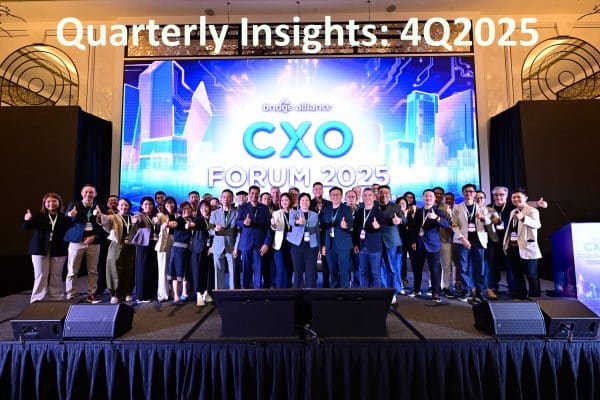
The Bridge Alliance team managed this group shot in the morning of our CXO Forum back in November – before the action began.
Hi everyone
Happy New Year! We hope you had a great start to 2026.
We had an exciting last quarter of 2025, as always headlined by our flagship event, in addition to us welcoming du as our member operator in the UAE! It was wonderful to connect with those of you who attended our CXO Forum and inaugural Telco API Forum in November, be it in-person or virtually. We emerged from them brimming with ideas for this year, in addition to getting inspiration from these trends that we’ve observed from the last quarter:
- 4Q 2025 confirmed that telecom operators are rapidly transforming into AI-native, API-powered digital infrastructure providers. Telcos globally are moving beyond connectivity to become platform enablers across enterprise sectors, underpinned by strategic expansion in APIs, private networks, AI clouds, and immersive engagement technologies. They are becoming digital infrastructure players aligned with national priorities, and internalising AI into org design and GTM.
- Satellite IoT is going mainstream, and IoT becomes “platform + commerce.” IoT is maturing into (i) hybrid connectivity as a standard, and (ii) productized distribution via marketplaces and partner ecosystems, with security increasingly embedded.
- Telco API monetisation is clustering around fraud/identity: SIM Swap, Silent Authentication, Number Verification are the “first wave” because they map to urgent enterprise pain points (account takeover, onboarding friction). This shows up in multi-country efforts and vendor platforms (e.g., Globe pushing next-gen authentication and expanding developer access via its marketplace).
- 5G Innovation is less about speed claims and more about software release velocity, automation, programmability, and NTN integration – i.e., building the platform to sell differentiated enterprise services.
- CPaaS is now a full-stack engagement platform, with compliance, analytics, and AI-native CX orchestration built in. UC/CPaaS is becoming a single “engagement operating system” where AI agents, messaging, and contact centers converge – but the winning factor is trust + data + reliability, not just the LLM.
- Telcos are becoming core enablers of sovereign AI ecosystems, building full-stack AI platforms for both internal transformation and external monetisation. Telcos are trying to own more layers of the AI stack — but with heavy partner reliance. Some exceptions exist (e.g., SoftBank intending to provide compute as a service; Deutsche Telekom offering Industrial AI Cloud services), but the monetisation angle is still unclear in many telco AI stories.
- Security is one of the few AI areas that shows a) urgency, b) budget, and c) alignment with telcos’ “trusted operator” identity.
- Private networks are moving into a new phase: (1) industrialization and cheaper deployment models, and (2) mission-critical + sensing + autonomy use cases that are hard to serve with Wi-Fi.
We’ve captured some of our Bridge Member Operator (BMO) year-end activities in the report below. Enjoy the read!
Cheers!
Bridge Alliance Research & Analysis Team
AI
We begin with AI news, where telcos are no longer treating AI as a feature. They’re declaring it as foundational to their future operating model, business model, and national role. Telcos are aligning AI with national priorities -from cybersecurity and health resilience to environmental sustainability – building trust as public-interest technology players.
Telcos are not only enabling AI, but are central to foundational, national and regional AI strategies, offering compute, data, and edge-native capabilities to public and private clients. Data sovereignty, regulatory compliance, and regional AI innovation have emerged as competitive differentiators. Operators are positioning themselves as trusted local AI stewards. Meanwhile, AI agents are no longer limited to chatbots – they’re now being embedded in networks, ops, and security, enabling autonomous decision-making across the telco stack.
There have been plenty of AI announcements from the BMOs. SoftBank launched a new AI platform powered by NVIDIA GB200 NVL72. It also announced that it would acquire data centre firm DigitalBridge Group to scale next-gen AI infrastructure, and ABB’s robotics division to strengthen its own AI robotics business.
On top of its $41 billion investments into OpenAI, SoftBank and OpenAI formed a JV to offer “Crystal Intelligence”, a localized enterprise AI solution for Japan. SoftBank also announced that it evolved its “Large Telecom Model” (LTM)*1 a generative AI foundation model designed for the telecommunications industry, into a Japan-developed AI model by integrating “Sarashina”, a homegrown large language model (LLM) with strong Japanese language capabilities developed by its subsidiary SB Intuitions Corp. This evolution enables secure, end-to-end data processing entirely within Japan.
In South Korea, SKT is also partnering OpenAI – it joined OpenAI’s “Stargate” global infrastructure program with memory support from SK Hynix. It also announced major expansions of its AI data centers (AIDCs) across Korea, and entering the global market with new partnerships. Meanwhile, its Adot Phone launched real-time AI-driven voice phishing detection and safe blocking, even while the call is ongoing.
SKT with other consortium members it is working with for the Ministry of Science and ICT’s “Independent AI Foundation Model” project —Liner, Selectstar, Krafton, 42dot, and Rebellion—is accelerating the implementation of full-stack AI by securing five competitive advantages of a Korean AI model. The SKT consortium is collaborating with each company, leveraging its expertise, to secure AI technology competitiveness that can be applied in real-world situations and in the global market.
Yet another BMO partnering OpenAI is Deutsche Telekom, which announced a multi-year collaboration to bring advanced AI capabilities to millions of customers and businesses across Europe. As one of the first companies DT gets early access to an alpha-phase model. With OpenAI, DT will design new AI-powered products and improve how people communicate. DT also landed a milestone partnership with NVIDIA to launch one of the largest AI factories in Europe.
The healthcare IT market is a focus industry for Deutsche Telekom. DT, the Fraunhofer Institute for Intelligent Analysis and Information Systems (IAIS), and Merheim Hospital are currently developing an AI-powered real-time display system based on trauma room simulations. The AI listens to and tracks the conversations of the medical team in the trauma room and categorises it according to medical priorities, in order to ease the workload for trauma teams, minimize errors, and ultimately – save lives. DT has also acquired synedra, an Austrian IT specialist for medical data management, which will expand its portfolio of data platforms and interoperability solutions.
DT has won a new contract worth tens of millions for its Industrial AI Cloud. Leibniz University Hannover has awarded the contract to provide the technical infrastructure for the SOOFI (Sovereign Open Source Foundation Models) research project in the AI factory.
DT’s RAN Guardian AI agents are now live and autonomously monitor network performance, assist in troubleshooting and optimise radio networks in response to local events;
Over in the Middle East, du and Nokia conducted a successful trial of Nokia’s AI and GPT-powered automation assistant designed to simplify and accelerate optical network expansions and operations, and improve network efficiencies, using Nokia’s Wavesuite AI. Du’s customers will be able to benefit from more reliable, SLA-backed connectivity for their mission-critical applications.
In Asia, Taiwan Mobile’s AI-powered platform “AI Blue” for ocean knowledge was launched in Palau with the support of the Ocean Affairs Council, marking its first application abroad.
Airtel has entered into a strategic partnership with Google to set up India’s first Artificial Intelligence (AI) hub in Visakhapatnam, Andhra Pradesh with an estimated $15 billion investment over five years. This landmark initiative will accelerate the adoption of AI across India, strengthen the country’s digital backbone and bring Google’s full AI-stack and consumer services closer to Indian businesses.
Meanwhile, Globe Business has partnered with global cybersecurity company Cyble to bring an AI-native threat intelligence platform to the Philippines. This marks a major step forward in transforming cybersecurity, arming local enterprises with the predictive defense needed to combat the nation’s rising wave of sophisticated cyber threats.
In Malaysia, Maxis introduced Miya (Maxis Intelligence, Your Assistant), making it the first telco in Malaysia to launch a generative AI (gen AI)-powered conversational in-app assistant in collaboration with Google Cloud.
5G & Innovation
Operators are no longer only trialing 5G-Advanced—they’re commercialising it with cloud-native, programmable architectures to support slicing, MEC, and AI-native services. Satellite-to-device (D2D) is becoming a differentiated telco offering. Europe, MENA, and Asia are deploying satellite-based 5G for both consumer resilience and industrial edge applications.
Telcos have deployed AI-powered solutions to make 5G networks self-optimising and monetisable; AI is becoming central to operational resilience, customer-level service differentiation, and new monetisation models (e.g. paid QoS tiers). Telcos are competing on sovereignty, compliance, and infrastructure control—not just speed—especially in high-trust or geopolitically sensitive markets.
SoftBank joined a group of three organisations including Japan’s National Institute of Information and Communications Technology (NICT), Kiyohara Optics and ArkEdge Space to work on the launch of an LEO satellite for optical wireless backhaul, aiming at ultra-high-speed, low-latency space-ground links.
Stc Group inked a satellite and teleport services with Telefonica’s global business unit, Telefónica Global Solutions (TGS which focuses on the development of satellite connectivity solutions, including tailored satellite services across Low Earth Orbit (LEO), Medium Earth Orbit (MEO) and Geostationary Earth Orbit (GEO) networks. Stc signed a 10-year agreement with AST SpaceMobile, becoming the region’s first operator to offer direct-to-device satellite broadband and eliminate connectivity gaps in Saudi Arabia.
Meanwhile, SK Telecom signed an MoU to develop 5G-enabled military relay drones, using low-band commercial spectrum to extend reach in urban environments.
Telkomsel continues to expand on 5G; it partnered ZTE Corporation to deploy Hyper 5G in Makassar, South Sulawesi. This initiative marks a significant milestone in the joint efforts to deliver high-performance digital connectivity to Eastern Indonesia.
Stc Group in collaboration with Nokia, has announced the first successful commercial deployment of 5G Non-Standalone (NSA) Cloud RAN in the Middle East and Africa’s (MEA) region. By leveraging Nokia’s Cloud RAN capabilities, stc is targeting to gain the benefits of Cloud RAN including network automation, programmability, architecture agility and flexibility as well as the introduction of new services and use cases.
In Saudi Arabia, stc has inked a five-year Master Frame Agreement with Ericsson to advance the Kingdom’s digital infrastructure. Through the agreement stc will tap Ericsson’s latest portfolio offerings including: 5G hardware and software, cloud-native solutions, advanced managed services, and infrastructure and network support (including third-party product (3PP) components).
In Vietnam, MobiFone and conglomerate Sovico Group have signed an MoU for comprehensive cooperation aimed at building a multi-utility technology and services ecosystem to support national development. The partnership will focus on deploying 5G networks while integrating base station infrastructure with IoT, surveillance cameras, and smart connectivity solutions. Both sides also plan to cross-sell products and services, expand digital financial offerings, develop enterprise digital transformation solutions, and co-create digital content.
Meanwhile, MobiFone, together with Viettel, is partnering The State Bank of Vietnam in its central bank digital currency pilot, which opens new opportunities for telecom giants in digital finance.
Private Networks
Private 5G is maturing as a versatile tool for large-scale industrial, healthcare, and logistics environments, enabling AI/IoT at scale, real-time operations, and lower TCO vs. legacy networking. Several deployments (Port of Tyne, Ericsson and Airbus) demonstrated tangible benefits in high-demand, high-complexity sites.
Private 5G is evolving from “secure local Wi-Fi replacement” to mission-critical enabler—suitable for autonomy, aviation safety, industrial precision, and edge AI applications; new solutions are breaking cost and complexity barriers. Telcos are finding ways to industrialize private 5G deployments, enabling them to serve more verticals with faster ROI.
A handful of announcement from our BMOs:
Telkomsel’s UE-transparent Hybrid Private Network (built with ZTE) allows public-private network coexistence without needing separate radios, using IMSI-based selection + AI traffic shaping; while ZTE also partnered China Unicom in launching a 5G-A ISAC private network at Dalian Changhai Airport. The system fuses mmWave 5G with precision radar-like sensing to monitor airfield threats like drones or birds in real time.
China Telecom in partnership with ZTE, proposed an innovative “Factory-to-User” solution spanning the entire vehicle lifecycle. Leveraging 5G to achieve “one-card connectivity”, it links two core segments—a 5G-A private network for factory manufacturing and wide-area usage, via a nationwide multi-DNN (Data Network Name) customized private network + LBO (Local Break Out) routing mode. This solution has become a key driver for cost reduction, efficiency gains, and faster deliveries.
du Infra (UAE) deployed a dedicated standalone 5G+ private network for A2RL, the world’s largest Autonomous Racing League, proving its ultra-low-latency, high-reliability performance in dynamic real-time use cases.
IoT/M2M/Mobility
In IoT news, satellite IoT has moved from R&D into commercial-grade availability with real market deployments. Operators and tech firms are converging terrestrial and satellite for always-on, global coverage – critical for agriculture, asset tracking, remote utilities, and logistics.
Automotive IoT is moving beyond telematics to deeply integrated, real-time autonomy support. Remote operation, AI-assisted autonomy, and bundled connectivity services are becoming core to long-haul and commercial fleet innovation.
Telcos are formalising IoT as a core business line, investing in dedicated units and brands. Growth is now measured in millions of active lines, with enterprise and regulatory drivers unlocking new volumes. Telcos and vendors are now building partner-first platforms with lifecycle security, APIs, analytics, and vertical support. The model is shifting from hardware to managed service ecosystems.
There were a handful of announcements from the Bridge Alliance ecosystem. Our IoT platform partner Aeris recently announced the expansion of its global partner ecosystem, adding 8 new partners (VARs, MSPs, ISVs) and enhancing its Aeris IoT Accelerator and IoT Watchtower security suite.
Together with Aeris, we were delighted to win a silver in the Cyber Security Award category at the World Communication Awards (WCA) 2025, for Aeris’ IoT Watchtower ™ solution! Winners were announced at a ceremony in London on 9 December.
In Indonesia, Telkomsel and smart device brand BARDI launched connected dashcams with instant SIM activation, real-time telemetry, and centralized fleet management for a safer and more connected driving experience.
Edge / MEC / Cloud
On the cloud front, telcos are evolving from cloud resellers to cloud operators and ecosystem orchestrators, particularly for AI workloads with sovereignty requirements. Partnerships with the likes of Amazon Web Services, IBM, and Oracle are now a strategic norm, not an exception.
AI + edge compute are no longer abstract. Operators are delivering verticalised AI clouds (manufacturing, ERP, public sector) and remotely orchestrated edge nodes, creating industry-specific cloud platforms. In regulated sectors and AI deployments, sovereignty equates competitiveness. Telcos that offer trusted, local cloud infrastructure will win more B2B workloads and government contracts.
In South Korea, SK Telecom, AWS and SK AX (the company ‘s AI transformation service partner) launched a joint push into the AI cloud sector, blending AWS services (e.g. Bedrock, SageMaker) with SKT’s AI infra for hybrid, GPU-powered AI clouds tailored to regulated industries. The wider SK Group is building a “Manufacturing AI Cloud” using NVIDIA’s Omniverse platform, targeting factories and industrial AI use cases (first in Asia). The manufacturing AI cloud will be built, operated, and serviced by SK Telecom, based on approximately 2,000 of the latest NVIDIA GPUs (RTX Pro™ 6000 Blackwell Server Edition).
In India, Bharti Airtel has partnered IBM to augment its recently launched Airtel Cloud. They aim to enable enterprises in regulated industries to scale AI workloads more efficiently, delivering interoperability across infrastructure including on-premise, in the cloud, across multiple clouds and at the edge in industries with greater regulation like finance, healthcare and the public sector.
SoftBank & Oracle announced sovereign cloud and AI services for Japan via Oracle Alloy, giving customers access to 200+ Oracle Cloud Infrastructure services within local data centers. SoftBank has also succeded in providing limited services that utilize “Segment Routing IPv6 Mobile User Plane” (“SRv6 MUP”) via Fixed Wireless Access on its 5G commercial network. SRv6 MUP is an affordable and easy-to-set-up technology that takes advantage of 5G*1 features that enable services such as Multi-access Edge Computing (MEC) and network slicing, to provide low-latency services to more customers.
Deutsche Telekom’s IT services unit T-Systems has launched a turnkey business transformation product T-Systems @Vantage that offers AI-based cloud services for digital transformation.
In the Philippines, Globe Business has partnered Salesforce to harness the latter’s cloud and AI solutions to reduce its overall customer service workload by 34%. This frees up employees to focus on more complex, high-value customer interactions.
China Telecom partnered with Huawei and TD Tech to jointly develop a 5G-based Edge Cloud + Robotic Guide Dog solution. This project recently completed a successful pilot program in Shanghai, validating both its technical and business feasibility in supporting mobility for the visually impaired and laying a solid foundation for future commercial deployment.
Enterprise
The last quarter showed operators doubling down on market control, spectrum scale, and margin improvement via full ownership and technical integration of prior JVs or acquired units. Operators are forming cross-border alliances to improve supply chain efficiency and launch joint services.
Partnerships are focusing on cross-border security, roaming, infrastructure sharing, and procurement synergies. Cybersecurity is becoming a core pillar of telco enterprise offerings – targeting banking, healthcare, and SME sectors through both commercial and public sector channels. In emerging markets and national tech strategies, telcos are being formally embedded into public sector transformation, acting as digital infrastructure arms of the state.
du and China Telecom Global announced their strategic partnership to explore and develop innovative telecom solutions that drive the UAE’s Smart Nation ambitions, while stc Bahrain has announced a strategic collaboration with Bahrain Development Bank (BDB) to deliver comprehensive cloud and cybersecurity services.
Singtel launched Hybrid Quantum-Safe Networks, the region’s first, that integrates Quantum Key Distribution (QKD) with Post-Quantum Cryptography (PQC), a layered approach that delivers cost-efficient, flexible and globally extensible protection against emerging quantum threats. In partnership with Enterprise Singapore (EnterpriseSG) and the Infocomm Media Development Authority (IMDA), Singtel also launched the Singtel Cyber Protect Programme, a strategic public-private collaboration to bolster the cyber resilience of Singapore’s SMEs.
Airtel Africa’s Nxtra has inked a multi-year partnership with Vertiv, the global critical digital infrastructure and continuity solutions provider to build one of the largest data centre networks across the continent, starting in Nigeria where the first project, a 42-megawatt (MW) facility is expected to be operational in 2028.
SK Telecom saw a major restructuring exercise, including a broad effort to bring together its various AI-related divisions. SKT restructured into two CICs (Company-in-Company): MNO and AI, with B2B and enterprise GTM functions aligned around digital infrastructure and AI platform delivery.
In Malaysia, Maxis announced a strategic partnership with global telecom solutions provider Globe Teleservices Pte. Ltd. (GTS) to deploy an integrated AI-powered firewall for messaging and voice traffic across the Maxis network in Malaysia. This fully managed, end-to-end service is designed to enhance network security and quality and improve the integrity of international messaging traffic delivered into the country.
MobiFone signed agreements with Vinh Long province and police to deploy private networks and smart governance platforms. Eight key leaders of the telco were appointed to the Public Security Force – this follows a transfer in February 2025 of MobiFone’s governance to the Ministry of Public Security.
In Cambodia, Metfone entered into a strategic partnership with Cisco to bring advanced technology solutions to the Cambodian market, in a signal of its transformation from its traditional role as a telecommunications network operator to a comprehensive technology solutions provider for businesses, organizations, and government agencies nationwide.
The Travel Alliance, comprising Singtel, AIS, Taiwan Mobile, GOMO Philippines, KDDI, Telkomsel, Optus and HKT—have officially launched WanderJoy, the world’s first cross-border rewards programme by telcos, which will connect their millions of customers to a multitude of benefits and exclusive travel privileges that can be redeemed easily across borders.
Airtel Business secured a multi-year contract from Indian Railway Security Operations Centre (IRSOC) to deliver comprehensive, industry-leading security services to safeguard the digital backbone of India’s railway network.
Telco APIs
In network API news, APIs for secure onboarding and fraud prevention – like SIM swap detection and network-based verification – are now live and monetized across multiple geographies. These APIs are becoming default requirements across banks, FinTechs, and marketplaces.
Operators are embracing federated API architectures, enabling inter-carrier trust signals and authentication APIs across borders to power secure onboarding in new markets. The telco API economy is moving from bespoke integrations to platform-based delivery—whether via hyperscaler marketplaces, telco exchanges, or dedicated API storefronts.
Monetising network APIs is not just about exposure—it requires packaging, abstraction, and ecosystem GTM. Strategic vendor partnerships are critical to reach scale, and the GSMA and TM Forum have made available a new joint conformance certification program. This programme enables certification of TM Forum Operate APIs which helps to accelerate the global API economy and enables CSPs to monetize network capabilities and data at global scale.
In the last quarter, China Unicom, HKT, Huawei, and EngageLab launched the OpenGateway Cross-Operator Authentication Solution, enabling “one access, global invocation” for identity services like OTP and number verification.
Globe Telecom, following its GSMA certification on Number Verification API earlier this year, is helping organisations adopt API-based security frameworks that strengthen customer protection and prevent digital fraud.
In India, on top of their individual fraud-prevention programmes, the three largest mobile operators, Airtel, Reliance Jio and Vodafone idea are working together as a mobile ecosystem, through the GSMA Open Gateway initiative, to provide banks and other online platforms with new, federated ways to verify customer identities and combat digital fraud . They also teamed up with the GSMA to organise an inaugural GSMA Open Gateway Hackathon at India Mobile Congress to accelerate development of new innovations and network API based services using network capabilities.
Web3
Cloud gaming is a real, monetizable 5G consumer service, especially when paired with premium devices and latency guarantees. It also positions telcos to control edge streaming experiences for VR/AR headsets. The smart glasses space is still hardware-first, but telecoms could find future opportunities in network-aware OS features, Gemini integration, or bundling these XR devices with 5G+ cloud platforms.
Some operators are evolving Metaverse projects toward practical, high-value business utility – especially for venue planning, B2B hospitality, and digital twin experiences
Telcos are tentatively entering the blockchain-as-a-service (BaaS) and crypto services domain, with early focus on infrastructure monetization, not tokens or NFTs.
In the last quarter, Deutsche Telekom expanded its 5G+ Gaming offer with NVIDIA GeForce NOW, providing exclusive access via the MeinMagenta app – one of the most mature mobile cloud gaming implementations in Europe.
Meanwhile, the UAE saw du launch “Cloud Miner,” a subscription-based crypto mining service using its existing data centers – a first for the region, aligned with regulatory compliance and sustainability messaging.
Unified Communications/Communications Platform-as-a-Service
On the unified communications front, CPaaS and Contact Center boundaries are dissolving. Platforms are converging into AI-first, full-stack engagement clouds—spanning voice, messaging, orchestration, and agent tools. Telcos are evolving as service aggregators and experience enablers. Through partnerships, telcos are embedding global CX stacks into network-aware digital journeys/
AI-first orchestration has moved from chatbot-level automation to deep, agentic customer workflows: Agentic AI is now powering intent-driven, cross-channel, secure engagement flows, embedded deeply in both CPaaS platforms and contact center infrastructure.
As AI agents scale, data integrity, real-time context, and resilient ops stacks are becoming competitive differentiators for telco-aligned CX platforms. Cloud-native contact center and CPaaS solutions have expanded their geographic and regulatory footprints: CPaaS players are winning in diverse markets through hybrid deployments, regulatory alignment, and localized AI experience delivery.
. . . . .
 English
 Arabic
 Chinese (Simplified)
 Chinese (Traditional)
 Dutch
Dutch Filipino
 French
 German
 Hindi
Hindi Indonesian
 Italian
 Japanese
 Korean
 Malay
Malay Portuguese
 Russian
 Spanish
 Tamil
Tamil Thai
Thai Vietnamese