



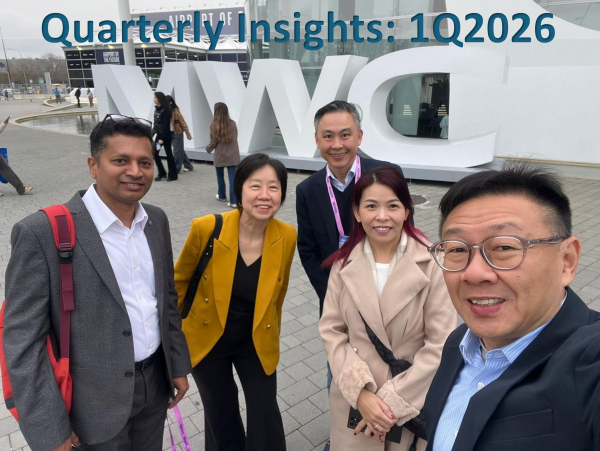
Our colleagues attending MWC Barcelona 2026.
Hi everyone
It’s been a busy first quarter with the MWC Barcelona setting the stage for the industry themes to come for the rest of the year, as always. Here are some of the key topics that emerged:
- AI is becoming the organising layer of the telco. AI is no longer being treated as a side initiative. It is becoming the operating logic across networks, customer experience, security, and enterprise products. In 1Q, operators and partners pushed AI into network maintenance, routing optimization, digital twins, call assistance, churn prevention, enterprise sales, contact centers, fraud protection, and sovereign AI infrastructure. AI is moving from experimentation into industrialization inside the telco stack!
- Sovereignty and trust are becoming strategic differentiators. Operators are emphasising sovereign cloud, local control, regulatory alignment, trusted AI, secure communications, and national resilience. This shows up in Singtel’s sovereign AI services, AISpace and Thai AI ecosystem positioning, and public-sector or national resilience initiatives in Japan, Singapore, and the Philippines. Telcos are competing not just on technical performance, but on jurisdiction, governance, and trustworthiness.
- 5G is shifting from coverage and speed to programmability and service assurance. Operators are trying to turn 5G into a programmable network platform that supports premium enterprise connectivity, AI workloads, XR, mobility, and large IoT environments. The network is being exposed through APIs, dynamically optimized with AI, and linked to service assurance models such as SLAs and differentiated performance tiers.
- Network APIs are moving from concept to commercial reality, but in a narrow first wave. There is real progress in network APIs: more aggregation, more standardisation, better developer access, and more commercialization. But the market is still concentrated around a narrow group of products.
- Unified communications, contact centre, and CPaaS are converging into AI-first engagement platforms. Providers are competing on who can orchestrate communications, AI, CRM context, and workflows into a single customer engagement engine. Telcos play an important role as distributors, trusted network partners, and compliance enablers.
- Partnerships are the dominant commercial model. Operators are pairing with hyperscalers, AI vendors, CPaaS firms, systems integrators, security firms, and industrial players.
Bridge Alliance was at MWC Barcelona as always, taking the stage to speak about telco API expansion. Our former CEO Geok Chwee addressed anti-fraud initiatives that are driven by telco capabilities among our Bridge member operators (BMOs). Meanwhile, our current CEO Boon Chee delivered a keynote and spoke on a panel about multi-market GTM and scaling regional API consumption during the Open Gateway sessions.
MWC Barcelona ‘26 marked the end of an era of sorts as Geok Chwee’s last MWC representing our company before her retirement to pursue personal interests, while we welcomed Boon Chee as our new CEO from April to continue driving our Bridge vision of Accelerating Growth as ONE!
More Bridge community and industry observations below.
Cheers!
Bridge Alliance Research & Analysis Team
AI
Telcos are becoming AI infrastructure providers, not just AI users. Operators are moving beyond adopting AI tools and are positioning themselves as providers of AI-ready infrastructure, compute environments, and sovereign AI platforms. The GSMA has launched Open Telco AI, a global industry initiative designed to accelerate telco-grade AI through open collaboration across operators, vendors, AI developers and academic institutions.
- Deutsche Telekom continues to build out its AI factory and is attracting sovereign vertical applications such as Noxtua’s legal AI – the company develops Europe’s sovereign Legal AI for legal professionals in law firms, corporations, public administration, and the judiciary;
- Singtel is developing its sovereign AI cloud and Centre of Excellence with NVIDIA, combining data center capacity, sovereign cloud, and industry enablement;
- SoftBank launched Infrinia AI Cloud OS as a software stack for AI data centers and continues to build out infrastructure around GPU cloud services; and
- SK Telecom is expanding its AI data center ecosystem with partners such as Supermicro and Schneider Electric.
Sovereign AI has become a major strategic theme. AI is not only a technology race but also a jurisdiction and trust race:
- Deutsche Telekom’s AI factory is being positioned as a sovereign European environment, which is especially important for regulated sectors like legal services;
- Singtel’s RE:AI is explicitly framed as a sovereign AI environment for enterprises and government in Singapore;
- AIS launched AISpace in Thailand, presenting AI as critical national infrastructure, integrated with intelligent networks and global partners but localized for Thai requirements;
Agentic AI is moving into real telco operations; AI is moving from dashboards and copilots into decision-support and increasingly autonomous network operations:
AI governance, trust, and security are becoming strategic requirements:
- SK Telecom is deepening its company-wide AI governance, enhancing the use of its AI Governance Portal and launching a ‘Good AI’ campaign company-wide;
- SK Telecom’s data breach response and its CX transformation and new CX unit also shows that customer trust, AI data governance, and accessible service models are increasingly linked;
- Maxis continues embedding AI into fraud and spam prevention for voice and SMS.
Operators and vendors are looking for ways to turn AI into commercial products and new revenue streams, not just internal efficiency. In Hong Kong, Hutchison Telecommunications and AWS have launched the territory’s first telecom-Led AI Marketplace to empower SMEs in digital transformation
- AIS’ AISpace is building a commercial AI hub for Thai consumers and enterprises with multiple partner solutions;
- HKT and YuShu, a Chinese robotics company, are moving into “physical AI” by combining telecom infrastructure and robotics for enterprise adoption.
Real-time data and AI-ready operating models are becoming essential:
- Globe Business has partnered Confluent in the Philippines to position streaming data as the foundation for enterprise AI and digital agility;
- Singtel and Cohesity are trying to unlock value from enterprise backup data by turning it into searchable AI knowledge.
Other BMO news:
- Airtel and Zscaler Announce Launch of AI & Cyber Threat Research Center to Advance Cyber Resilience and Trusted AI Adoption
- Airtel launches new AI-powered protection from ‘frauds caused by OTP leakages
- Deutsche Telekom reimagines phone calls with AI embedded in the network
- Singtel Innov8 launches new US$250 million global AI Growth Fund to accelerate Singtel Group’s AI adoption
- SKT’s Haein Gains Momentum as a Core Driver of Korea’s AI Strategy
- SKT Unveils Next-Generation Automotive AI Agent ‘A.dot Auto’
- SKT’s AI-Smarter Filtering Technology Blocked 35% More Voice Phishing and Spam
- SoftBank Corp. Builds Multi-AI Agent Platform for its Large Telecom Model, a Generative AI for Telecom, and Commences Verification of Autonomous Operations
- SoftBank Corp. Develops “Autonomous Thinking Distributed Core Routing,” AI-driven Technology for Autonomously Optimizing Network Routes
5G & Innovation
In 5G news, congrats to Cambodia for its commercial launch of 5G at the start of the new year, with Metfone, Cellcard and Smart making 5G available in Phnom Penh and other key cities like Siem Reap in the initial phase. In Malaysia, Maxis and CelcomDigi have completed their respective transaction to acquire MoF Inc’s shares in Digital Nasional Berhad (DNB). Both telcos have paid RM327.87 million (US$82.7m) each.
Operators are no longer just building 5G Standalone (SA) for technical completeness. They are starting to link it directly to enterprise-grade service models. SA is becoming the foundation for predictable, differentiated services, not just faster mobile broadband.
- SoftBank & Ericsson focused on core modernization to accelerate 5G SA adoption and prepare for 5G Advanced and AI-driven operations.
- Singtel & Ericsson are explicitly tying 5G Advanced to commercial slicing with enforceable SLAs, premium tiers, and APIs for enterprises.
5G Advanced is being framed as an AI-native enterprise platform; the next step in 5G is not just radio evolution, but AI-assisted network behaviour. The network is becoming smarter in how it allocates resources, predicts conditions, and supports service assurance.
- Optus & Ericsson trialed an AI model for live 5G SA coverage prediction to improve handovers and reduce the cost and inefficiency of static.
- Singtel is also positioning 5G Advanced as AI-powered and programmable, in a collaboration with Ericsson to accelerate the evolution of 5G-A
Innovation is shifting toward industrial, security, and autonomous systems; and is more about packaging telco assets into vertical solutions.
- SoftBank’s Autonomous Building, an initiative with Tokyu Land Corporation, Tokyu Community Corp and SynapSpark shows telecom innovation extending into smart infrastructure and building-level operating systems.
- Singtel Enterprise and AGIBOT’s strategic agreement reflects telcos exploring embodied AI and robotics as a service layer for enterprises.
Satellite-to-device and non-terrestrial networks are becoming part of the mainstream 5G roadmap. NTN is no longer being treated as a niche or emergency-only concept. It is becoming a strategic extension of the mobile network, especially for resilience, rural coverage, disaster recovery, and sovereignty.
- Deutsche Telekom & Starlink aim to add a satellite layer that future phones can fall back on automatically when terrestrial mobile signals are lost, filling the last ‘white spots’ where network expansion is challenging due to demanding topography for example.
- Taiwan Mobile & AST SpaceMobile are working toward direct-to-cell resilience and basic connectivity in disrupted or uncovered areas.
- Aalto and Telkomsel add HAPS into the picture, showing that operators are exploring not just LEO but also high-altitude platform systems.
Private Networks
Private 5G is being framed less as a standalone network and more as a managed enterprise solution; the strongest common thread is that private 5G is increasingly being sold as a managed service with repeatable delivery, rather than a bespoke connectivity project.
AI and edge intelligence are starting to be bundled into the private 5G story; private 5G is no longer just about connectivity. It is being linked more directly to edge AI and physical AI outcomes. Scale and repeatability are becoming more important than one-off pilots; the market is moving beyond isolated flagship pilots toward multi-site and scalable deployment models.
IoT/M2M
The quarter suggests that IoT is moving further away from “connectivity alone” and toward hybrid, secure, globally orchestrated platforms built for enterprise scale. Hybrid terrestrial + satellite connectivity is becoming a mainstream IoT model; there is a growing shift toward multi-network IoT connectivity, especially the blending of terrestrial cellular and non-terrestrial networks. For example, Deutsche Telekom launched the world’s first multi-orbit IoT roaming model, combining terrestrial NB-IoT/LTE-M with GEO and LEO satellite partners.
Global IoT scale increasingly depends on orchestration, not just coverage; another major theme is that global IoT growth is being driven by better management of complexity rather than raw network reach alone. Security is becoming embedded into the IoT platform, not bolted on afterward. There is a growing convergence of IoT with zero-trust, SASE, and deep security controls.
Our IoT platform partner Aeris joined forces with Palo Alto Networks to integrate Aeris IoT Watchtower with Prisma SASE 5G to bring wireless IoT devices into the enterprise security fabric with DPI, DLP, and Layer 7 protection. Meanwhile, specialised by stc, the stc Group’s critical communications arm and Ericsson inked a deal to accelerate the development of advanced mission critical communication capabilities that support Saudi Arabia’s national public safety ecosystem. They will integrate IoT sensors and smart‑vehicle systems into unified communication frameworks.
Automotive, mobility, utilities, and public infrastructure remain anchor verticals. The quarter also reinforces that telco IoT growth is still being concentrated in a few high-value verticals.
5G IoT is becoming more realistic not through full-featured 5G modules everywhere, but through reduced-capability, lower-cost device classes that better fit IoT requirements; 5G IoT is evolving through RedCap/eRedCap practicality, making migration paths more realistic.
Some BMO and partner news:
- Globe Business and Aeris launched IoT Accelerator in the Philippines in February;
- In January, Aeris surpassed 100 million connected devices worldwide . This landmark achievement is a result of nearly 90 percent growth in additional device connections since the 2023 acquisition of the Ericsson IoT Accelerator Platform;
- Aeris in February also announced with Globe that it would launch its Aeris IoT Accelerator (IoTA) platform in the Philippines, targeting commercial availability by 3Q 2026.
Edge/MEC/Cloud
On the edge, 1Q 2026 shows a fairly clear shift from “edge as a concept” to edge and cloud as operational, sovereign, AI-ready enterprise platforms; Edge and cloud are being repositioned as the foundation for enterprise AI; they are being positioned as the infrastructure base for AI inference, agentic operations, and low-latency enterprise workloads.
SoftBank and Mitsubishi Heavy Industries are testing edge AI applications in an on-premises edge data center using SoftBank’s AI-RAN product AITRAS, combining AI-RAN, MEC, and secure local inference, while Deutsche Telekom and Google Cloud are applying multi-agent AI to autonomous diagnostics and remediation across multi-domain telecom networks.
Multi-cloud security and visibility are becoming core enterprise requirements; operators are increasingly selling cloud networking and security as an integrated proposition.
AI is increasingly being used to operate the cloud/network environment itself. Beyond hosting AI workloads, another important trend is the use of AI to manage and optimize the network and cloud environment – Deutsche Telekom’s MINDR is a strong example: a multi-agent AI system designed for autonomous diagnostics and explainable remediation across telecom domains.
Operators and providers are still relying heavily on partnerships and acquisitions to strengthen cloud and regional delivery capabilities.
Other BMO news:
- Deutsche Telekom, Orange, Telefónica, TIM and Vodafone achieve the first pan-European federated Edge Continuum at MWC 2026
- Deutsche Telekom Significantly Expands T Cloud Public
Enterprise
In the first quarter, telco activity shows operators moving further beyond connectivity into digital infrastructure, secure platforms, public-sector resilience, and partnership-led transformation services.
Telcos are deepening their role as digital infrastructure providers; operators are investing in or positioning around data centers, computing hubs, billing platforms, and payment infrastructure.
- Airtel’s Nxtra raised US$1 billion to expand its Indian data center footprint, reinforcing that data centers are a major strategic growth engine for operators;
- Singtel’s data centre arm Nxera opened a very high-density AI-ready data center in Singapore;
- Singtel and investment firm KKR fully acquired ST Telemedia Global Data Centres, underscoring the strategic importance of large-scale colocation and compute capacity;
- solutions by stc signed a major supercomputing contract with Saudi Aramco.
Enterprise growth is increasingly partnership-led; strategic partnerships are used to accelerate enterprise scale, enter new solution areas, or extend geographic reach:
- Globe and NCS created a larger ICT platform in the Philippines aimed at cloud, data, and AI delivery;
- Telkomsel’s all-digital prepaid card by.U and Circles launched a next-generation SaaS platform, reflecting telco transformation from a complex legacy environments.
Public-sector resilience and national infrastructure are a major enterprise opportunity; operators are involved in national resilience, public safety, or core national systems:
- Japan’s five carriers including SoftBank launching JAPAN Roaming, a nationwide emergency service is a striking example of operator collaboration around emergency continuity and disaster resilience;
- Singtel and Singapore’s HTX (Home Team Science and Technology Agency) deepened a strategic partnership around public safety, secure communications, slicing, and operational intelligence in Singapore;
- Globe and the Metropolitan Manila Development Authority’s collaboration on emergency plans for “The Big One” in the Philippines shows operators being positioned as emergency communications infrastructure.
Cybersecurity, fraud protection, and trusted communications are becoming embedded enterprise offers. Enterprise customers no longer want raw pipes; they want secure, resilient, compliant platforms:
- Airtel & Google combined carrier intelligence and RCS protections to create a more secure messaging experience and extend anti-spam credibility into modern messaging;
- stc Bahrain and online training provider CFI bundled secure connectivity with firewalling, CCTV, UPS, and protection solutions for critical financial operations.
Other news:
- MobiFone launches the MobiFone Digital Payments Joint Stock Company to modernise Vietnam’s payments system
- CTM acquires stake in its peer Hutchison Telecom Macau, and the latter has exited the territory due to mounting losses
- Singtel establishes Brazil sales office to accelerate digital transformation of multinational enterprises
- SK Telecom forms four trust subcommittees, deepens customer engagement
- Stc Group extends partnership with PLDT global to deliver enhanced international connectivity
- stc Kuwait signs training collaboration agreement with Australian University to strengthen future-ready capabilities
Unified Communications/CPaaS (Communications Platform-as-a-Service)
Unified Communications (UC), contact center, and CPaaS markets are converging into AI-first customer engagement platforms, with competitive advantage increasingly driven by orchestration, trust, compliance, and workflow integration rather than channels alone.
Agentic AI is becoming the new control layer for customer engagement; providers are shifting from basic bots and assistant features to agentic AI that can take action across workflows. Trust, verification, and secure communications are now central product themes: the market is no longer just selling “engagement.” It is selling trusted engagement. Enterprises increasingly want communications that are verified, branded, secure, and measurable, especially in regulated sectors like healthcare, financial services, and government;
RCS and rich business messaging continue to gain enterprise momentum; messaging is evolving from “channel selection” into channel orchestration, where RCS, WhatsApp, SMS, and voice are chosen dynamically depending on customer context, regulation, deliverability, and ROI. Telkomsel has expanded business messaging beyond SMS to RCS, rolling out a richer form of business text messaging that allows companies to send verified, interactive messages to customers, marking a first for a mobile operator in Indonesia as brands move beyond plain SMS.
Providers are designing around AI with human supervision; but they are not abandoning humans. Enterprises want automation, but not at the expense of compliance, empathy, escalation control, or accuracy. The winning model appears to be AI-led, human-governed engagement rather than fully autonomous customer service.
Telcos are increasingly acting as go-to-market partners for AI-powered CX platforms rather than trying to build everything from scratch. Telcos are not disappearing from the value chain. Instead, many are becoming distribution, trust, and service-enablement partners for AI-powered engagement platforms. Deutsche Telekom’s CoMind introduces a modular conversational AI platform with chat and voice bots that act as digital colleagues. Telekom CoMind conversational AI delivers accurate answers from company knowledge via voice and text, supported by advanced analytics.
Telco/Network APIs
The telco API market is moving from proof of concept to commercial scaling, especially around fraud prevention, authentication, platform aggregation, and developer access. Network APIs are starting to become a more concrete telco business line, though still concentrated in a fairly narrow set of use cases.
Fraud prevention and identity verification remain the main commercial entry point. The first wave of API monetisation is not about exotic 5G capabilities. It is about carrier-grade trust signals that solve immediate problems in banking, e-commerce, fintech, and digital onboarding. That remains the clearest path from APIs to revenue.
The market is moving toward aggregated access models rather than one-off operator integrations. The industry is trying to make APIs easier for developers to consume; Success depends on reducing onboarding friction, simplifying access, and creating a more software-like consumption model. The quarter shows more attention being paid to how developers discover, test, and integrate telco APIs, which is essential for broader adoption.
AI is beginning to shape the next phase of network API adoption.
Commercialisation is still concentrated in a narrow set of API categories; most of the commercial activity here is still around: Number verification; SIM swap detection; Silent authentication; Identity-linked anti-fraud; and Early Quality on Demand (QoD) examples.
Globe has expanded its alliance with Nokia to accelerate the rollout of open, standards-based network APIs across Globe’s partner and developer ecosystem, reinforcing a shift toward open telecom platforms. Under the expanded collaboration, Globe will gain access to Nokia’s full portfolio of network APIs through Nokia’s Network Exposure Platform (NEP), a cloud-native and programmable infrastructure designed to streamline API service delivery and support interoperability across diverse network environments.
Customer wins
To round up our updates, below are a couple of major wins from our BMOS. Congratulations!
- After a competitive tender process, stc Group has snagged a deal to build the Syrian government’s SAR 3 billion (US$800 million) Silklink project that aims to boost Syria’s optical fibre infrastructure and create a regional internet hub.
- In Malaysia, Maxis has been officially appointed by Malaysia Rail Link Sdn Bhd (MRL) as the Single Preferred Infrastructure Provider and Telecommunications Partner for the East Coast Rail Link (ECRL) project. This strategic partnership spans a 10-year period and solidifies Maxis’ role in powering one of Malaysia’s most significant national infrastructure projects.
. . . . .
 English
 Arabic
 Chinese (Simplified)
 Chinese (Traditional)
 Dutch
Dutch Filipino
 French
 German
 Hindi
Hindi Indonesian
 Italian
 Japanese
 Korean
 Malay
Malay Portuguese
 Russian
 Spanish
 Tamil
Tamil Thai
Thai Vietnamese